
Museums and Professions

Interpreting
Cultural Heritage
with Gisele Cipriani
Museums and Professions features a new professional figure from the cultural landscape, a sector that inspires new specialisations in heritage management and sharing every year: the Cultural Heritage Interpreter.
Museums and Professions, our in-depth section dedicated to both established and emerging professional roles within the field of cultural heritage management and engagement, is now enriched by a new perspective: the Cultural Heritage Interpreter.
From the outset, we wish to clear the ground of futile controversies, by-products of local, narrow-minded interests to which we are entirely foreign. For nearly forty years, as a research institute, we have endured these obstacles, which have forced us to continuously seek opportunities outside our own country—a nation no longer capable of recognizing anything that does not serve the advantage of some social, political, or economic power group.
Through this interview, we in no way intend to provide a roadmap for professional placement; nor are we interested in whether the new professions we present are already regulated within a bureaucratic climate saturated with protectionist rules. Such regulations rarely protect the consumer, but rather serve those “first-comers” who dictate who, what, and how one must act to survive and, if possible, fulfill those existential aspirations for which work is the primary vehicle. This is not our role: we are not journalists, labor consultants, or legal experts; we are researchers operating within the mechanisms of knowledge propagation. Even in this instance, the Italian Constitution, so frequently lauded in the political arena for mere electoral gain, is often disregarded.
Conversely, it is neither a crime nor immoral to highlight new professional perspectives that address emerging needs, by-products of our times, within the cultural sector and heritage management. It is the responsibility of those in charge, should that term still resonate within the halls of democratic representation, to recognize these trends and transform them, not into a legal battle of red tape, but into development for all. We must remember that an overly rigid system, however convenient it may be for a few, runs the risk of either shattering or becoming obsolete.
We therefore present a colleague, Gisele Cipriani, PhD in History from UERJ in Rio de Janeiro, who shares how her passion for her field and for teaching has evolved into a profound reflection on how cognitive activity can and must be supported at every opportunity, not least when engaging with cultural heritage. With our guest, we share a mission, one I have championed throughout nearly forty years of professional practice, the belief that we can truly perceive ourselves in our existential dimension only when we emerge from the “apnea” of daily life, now further fueled by the compulsive use of technology, to enter a space of reflection and awareness regarding our condition, perhaps through a shared and dialectical experience with our fellow human beings.

Gisele Cipriani
Born in Brasília and educated among Brazil’s academic elite, Gisele Cipriani is a historian with a robust research background. After earning her PhD in History from UERJ in Rio de Janeiro and gaining extensive experience in teaching and scientific dissemination, she moved to Italy in 2022.
Today, she practices as a Cultural Heritage Interpreter, specialising in creating deep connections between historical research and the local territory. Her mission is to enhance the “hidden gems” of small local communities through the principles of slow travel and sustainable tourism, transforming academic knowledge into an accessible and unforgettable human experience
If this need has been recognized, not only by us throughout all these years, but also by our Guest and countless thousands of individuals, it means that the system, the market, and the current cultural offering are no longer suited to our times. This is even without considering how often culture becomes enslaved to “cultural fetishism” or, worse, is scarred by political scandals. Such issues serve only to alienate the public from culture, causing it to be viewed as nothing more than a low-budget “reality show”.
Furthermore, for the first time on Network Museum, speaking of “reality” (those who practice science recognize positivity everywhere, without demonizing anyone: Galileo would agree), we are introducing a guest’s invitation to interview a colleague deemed essential for their expertise, in order to provide a complete vision of the subject at hand. To better describe the role of the Cultural Heritage Interpreter within cultural tourism activities, Gisele Cipriani requested the inclusion, in a specially dedicated section, of Suzana Amalia Nemeș, a Cultural Heritage Interpreter specializing in “Travel Design” and owner of “Amalia Travel Designer”.
Network Museum
Who is Gisele Cipriani?
Gisele Cipriani
My full name is actually Gisele Cristina Cipriani de Almeida. However, since moving to Italy, I have chosen to use my Italian surname, as my full name is quite long by local standards. I am married and have three children, two of whom are still young. We relocated to Italy from Brazil in 2022, and since then, I have been balancing helping my children adapt to their new country with rethinking my own professional path. Consequently, at the beginning of this year, I launched a project on LinkedIn titled: Ciò che resta (What Remains).
As a historian (Ph.D.), my primary goal is to bring the unknown to life. My doctoral thesis in Brazil focused on an administrative document written by a renowned 19th-century Brazilian historian during the Imperial era. It was a rare, unpublished manuscript. During my Master’s, I had to authenticate the document by comparing it with other letters signed by Francisco Adolfo de Varnhagen; I then developed my doctoral research around why he wrote it and why it remained unpublished during his lifetime. This illustrates the profound influence that historical mysteries have on me.
In January, I began publishing posts and newsletters on historical topics that are rarely discussed abroad, specifically focusing on the history of the regions where I now reside: Lake Maggiore and Lake Orta. My aim is to grant visibility to small Italian towns that lack tourism support by sharing their history, thereby helping them develop sustainable tourism activities in alignment with the 2030 Agenda. My Italian followers have since helped me build Ciò che resta – dialogo tra i laghi on LinkedIn. I am incredibly enthusiastic about writing for the Italian community, as they truly appreciate and support my work.
I later connected with my colleague and coach, Suzana Amalia Nemes, via LinkedIn. While I was working as a historical communicator for my local area, Suzana suggested that I could transform this passion into a formal profession. She helped me prepare and become more aware of my role as a Cultural Heritage Interpreter. I now aspire to assist individuals and museums as a consultant, creating something that goes beyond traditional historical dissemination. I am deeply inspired by the idea of building experiences that transcend conventional museum exhibits. I want to enhance how visitors experience museums, elevating it to a level that connects them with the past and makes their cultural journey truly unforgettable.

Network Museum
How would you define culture, and what role does it play today?
Gisele Cipriani
When we reflect upon history, the early civilizations that settled along waterways represent the first moment humanity felt the need to build an organized structure. This was the dawn of society as it has evolved into the form we recognize today. As these societies began to interact with other communities, a differentiation between them became evident, and perhaps necessary. It was in this context that culture emerged as the defining identity of a group.
Naturally, this is a simplified explanation, but I believe that culture is the very essence of a society, and that is why we are so inherently drawn to it. This is precisely why governments should consistently invest in this field: ultimately, the need for identity resonates within every individual who chooses to live within a specific community.
Network Museum
How would you define a museum, and what should be its role in contemporary society?

Gisele Cipriani
A museum is a space that exists to bring a culture to life. By revitalising culture in this way, the museum reveals an identity. For instance, when we consider the Louvre and one of its masterpieces, the Mona Lisa, we often wonder: why is it so famous? Why does every visitor feel compelled to see that specific painting? It is because it represents a masterpiece by one of the most significant artists in Western history; it is a symbol through which we identify our own cultural heritage. The museum plays such a vital role in our society because its mission, to breathe life into the past, is something with which society profoundly resonates and through which it identifies itself culturally.
This is why it is so crucial to look beyond the surface and truly listen to what the past is trying to communicate, making choices that align with the present needs of our communities. A museum has the power to build bridges just as it can help dismantle walls. It is a formidable institution that must become increasingly present to help our society evolve and grow.
Network Museum
What is the true essence of Cultural Heritage Interpretation?
Gisele Cipriani
Drawing from my experience, it means looking beyond the heritage itself. It involves striving to connect with history and discovering alternative facets of the past; helping people become more deeply aware of the historical dimension. To summarise: it means empowering visitors to take an active role in engaging with the themes presented within a museum journey, moving beyond the passive role of being mere recipients of knowledge.
Network Museum
What is the role of a Cultural Heritage Interpreter, and how does one become one?
Gisele Cipriani
The role is to act as the bridge between the heritage and the visitor, not in a strictly academic sense, nor as a traditional tour guide, but as someone who ensures that visitors leave with an unforgettable and meaningful experience. This acquired knowledge then empowers them to share and disseminate what they have learned, inspiring others to seek out the same experience. Museums often take the role of the visitor for granted. Yet, it is the audience itself that has the greatest power to promote a museum. Reflect on your last museum visit: how did you hear about it? What were your expectations based on what you had heard? The role of a Cultural Heritage Interpreter, therefore, is to ensure visitors feel welcomed as intelligent, active individuals who, through this remarkable experience, can then advocate for the museum’s richness among their friends and family.
To become a Cultural Heritage Interpreter, a specific degree is not strictly required; however, a solid foundation in the field in which one intends to operate is highly beneficial. Above all, it requires a true vocation for creating something unique: the ability to foster empathy and connection with visitors, and a steadfast commitment to rigorous preparation and in-depth research into the subjects presented to the public.
Network Museum
How does one engage with museums and the national museum system? What does a Cultural Heritage Interpreter represent for a museum, and how does an institution benefit from this professional expertise? Furthermore, what are the critical aspects of this relationship?
Gisele Cipriani
I am currently at the beginning of my professional journey here in Italy. As I mentioned, I am driven by historical research, yet I am more open than ever to assisting museums in rethinking both the role of the visitor and the role of the museum itself. I see the museum as an active component in the development of historical knowledge, one that can build bridges within our society to help us evolve as human beings. I work closely with the Terre Borromeo Museums on Lake Maggiore, which recently established Kaleon Heritage Management. This private company could serve as an inspiration to many Italian and European museums through its distinctive investment and management model.
Unfortunately, certain development frameworks are currently more easily adopted within the private sector. My goal, therefore, is to propose similar management models for both public and private institutions, specifically for implementing systems that foster sustainable tourism. This would allow smaller towns outside the major tourist circuits to offer a cutting-edge experience.
Network Museum
How do you view museum visitors? Why do people visit a museum? And on that note: does one simply ‘visit’ a museum, or should one “frequent” it?
Gisele Cipriani
A museum visitor becomes a living, active component when they feel a true connection with the site or the structure hosting their experience. In the age of AI, it is common knowledge that information can be accessed quickly and easily. However, I do not believe that technology is intended to, nor could it, replace the museum institution or its guides. Rather, I believe in the educational contribution of technology. It is therefore vital for a museum’s evolution to invest not only in digital tools but also in the experiential aspect, which is the core domain of a Cultural Heritage Interpreter.
We help museums “connect the dots”, enabling them to curate and present exhibitions in a way that allows visitors to feel active rather than passive. I believe that when we choose to visit a museum, it is often because of word-of-mouth or something we have seen on social media. Furthermore, we visit museums to discover how we connect with our ancestors and how we can breathe life into the memory of our past. When a museum possesses the capacity to provide a genuine experience, every visit is different: this is how a visitor becomes a ‘frequenter’ rather than a one-time guest. For this to happen, however, museums, starting with the most famous institutions, must be more open to change. Unfortunately, the more prestigious an institution is, the higher its attendance tends to be, which often stifles the motivation to evolve.
Network Museum
How do you view the “market” , and what is your relationship with this dimension? Are there ethical responsibilities and boundaries to consider in the process of cultural heritage interpretation, particularly regarding a museum’s economic interests or social impact? What are they, and what conduct should be observed?
Gisele Cipriani
I believe that everyone has a specific role to play within a museum. The curator’s task is to organize the exhibition so that visitors can truly grasp our past or the specific era upon which the research is focused. The guide’s role is to convey information and insights about the display, providing historical context and a ‘reading’ of the artworks. The Cultural Heritage Interpreter, however, assists the curator in thinking beyond art and history and supports the guide by actively engaging visitors through the experience. It is all interconnected.
Our intention is not to infringe upon the professional space of others; rather, our task is to help them deliver a more immersive educational impact, thereby fostering increased museum attendance. The Cultural Heritage Interpreter is neither the guide nor the curator, but rather the professional figure capable of interacting with visitors in a way that engages them beyond mere listening, beyond simple viewing, and beyond their physical presence alone.

Network Museum
In what way can cultural communication influence existential awareness, both on an individual and a collective level?
Gisele Cipriani
This question resonates deeply with the role of a Cultural Heritage Interpreter. As human beings, we are in a constant state of evolution. Through communication, and, crucially, through silence at the opportune moment, the Cultural Heritage Interpreter has the capacity to help visitors connect with their own existential self-awareness. The ultimate goal is to assist individuals and groups in leaving the museum with the profound realization that the experience of the visit has contributed something meaningful to their very existence.
Network Museum
How do you view the theme of inclusion in terms of the accessibility of spaces, educational tools, and content within the interpretative process?
Gisele Cipriani
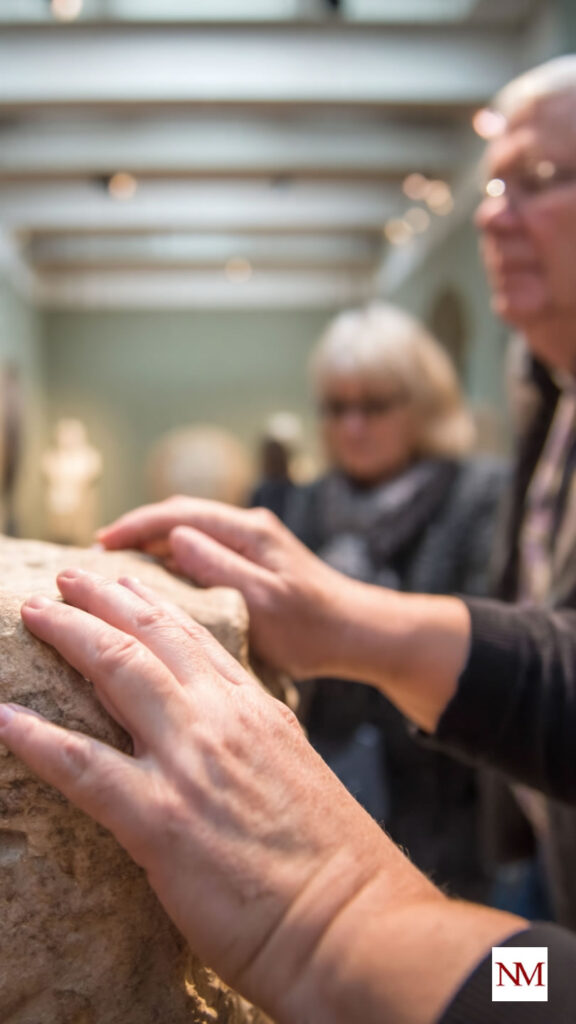
I have read about certain museums that organize special tours for the visually impaired, and I found the concept to be truly remarkable. They allow these visitors to touch the artworks, enabling them to truly feel the art and define their own personal configuration of it. This is a beautiful and profound example of genuine inclusion.
If we view museums as institutions responsible for culture and identity, I believe these organizations still have much to learn. Inclusion should encompass more than just physical accessibility; it must also involve the storytelling of those figures from our past who achieved extraordinary things despite their disabilities. Figures such as Stephen Hawking or Ludwig van Beethoven come to mind. We frequently showcase their masterpieces, yet we seldom discuss their disabilities as an integral part of their journey.
Another crucial example, which may not pertain strictly to physical disability but is equally vital to address, is the mental health struggles of certain artists, such as the profound depression that affected Vincent van Gogh. By integrating these narratives, we make the human experience more authentic and inclusive.
Network Museum
What kind of relationship exists between your professional role and various educational, academic, and scientific institutions?
Gisele Cipriani
As an academic, I firmly believe that our primary responsibility is to nurture and guide future generations. It is essential for schools, universities, and scientific institutions to embrace research that empowers museums to evolve. In this context, the Cultural Heritage Interpreter acts as a bridge, contributing practical experience and posing the right questions to stimulate fresh ideas and field research.
For instance, during a recent visit to the Borromeo Castle in Angera, I observed a class of students dressed in period costumes. Some were dressed as medieval warriors, complete with swords, engaging with the castle’s history as if they were living in that era. I learned that this is a structured activity organized by the local museum for students. This is a prime example of how a cognitive-sensory role-playing experience can create an enduring, lifelong connection between students and the museum.
Network Museum
How does your work relate to the expectations of an audience increasingly accustomed to technological devices, virtual effects, and mediated experiences?

Gisele Cipriani
To evolve, we must adapt. Therefore, technology is more than welcome; we should work alongside it. You see, the experience itself is unique, an exclusive aspect of each individual. Anything that fosters a connection or engagement should be presented, discussed, and shared. I practiced this throughout my years as a history teacher in Brazil. For instance, when my students were studying World War II, I would introduce the X-Men so they could relate to the material. I compared the feelings of the mutants, their sense of being “different”, and how that feeling could evolve into either malice or heroism.
I would draw parallels between Hitler’s rhetoric and General Hux’s speech in Star Wars: The Force Awakens. In other activities, I compared Anakin Skywalker to Julius Caesar, or showcased the Colosseum through the lens of the Petranaki Arena scene with Padmé in Star Wars: Episode II. We should embrace both the present and the future to breathe life into history. This is a truly powerful tool.
Network Museum
What are the risks, the drawbacks, and the benefits of the technological pressure currently facing the museum system? How do you view the learning process and its impact on individuals in a society increasingly defined by “speed” ?
Gisele Cipriani
We should embrace technology, but we must be vigilant not to let it lead us toward superficiality. It is as simple, and as challenging, as that.
Network Museum
In a world constantly pressured by omnipresent technology, how do you view activities such as cultural travel, which still rely on the relationship our senses establish with places and objects, specifically in relation to heritage interpretation?
Gisele Cipriani
I believe that artificial intelligence only replaces humans in tasks they are unable to perform. People love to meet, to get to know one another, and to socialize; they deeply value a real, human experience during a cultural journey or within a museum. However, when we enter these sites as tourists, we often feel somewhat lost in the face of such incredible places, with so little to explain what we are seeing or what we are standing before.
Reading captions is not enough. Listening to audio guides is not enough. These devices are technologies, and we perceive them as “cold” and distant, whereas people are seeking to establish ” warm”, empathetic, and human connections with what they are trying to understand and interpret. This is where a Cultural Heritage Interpreter intervenes, transforming ‘things’ and concepts into relationships. This professional figure can assist you before your journey to understand what kind of experience you are seeking and help you realize it. They can also assist you on-site, not as a traditional tour guide, but as a specialist who knows exactly where you should pause to look and truly feel.

A guide can also be a Cultural Heritage Interpreter, or they may remain strictly a guide. It all depends on their approach. If they merely convey information without fostering a relationship with the subject matter, then AI might actually be more useful. However, if they contribute something unique, if they stimulate something more deeply human, such as a reflection or even a simple question that encourages the visitor to engage voluntarily, then they are truly interpreting.
This is why I invited Suzana Amalia Nemeș to join me within the Network Museum space. This is exactly what she does when, in designing cultural journeys and stays, she carefully crafts the experience for her clients here in Italy.
Network Museum
What role does travel play in the cognitive process and in the design of cultural heritage interpretation?
Gisele Cipriani
One can partake in “consumerist” travel, the standard package tour, or one can choose to have a true experience. When you visit Paris, for example, you can plan it yourself: visit the Louvre, the Eiffel Tower, Galeries Lafayette, the Arc de Triomphe, the Champs-Élysées, and even the Musée d’Orsay. You take the selfie, check the box, and say: “I’ve been to Paris, done! Next”.
In contrast, when you have the assistance of a Cultural Heritage Interpreter helping you build an experience, a journey to Paris becomes something entirely different, which I will outline in four key stages.

First, the Interpreter engages in a dialogue with you to deeply understand your expectations.
Second, they analyze your personal history: who you are traveling with and the purpose behind the journey.
Third, based on this insight, the Interpreter curates an itinerary of historical sites, often those far removed from mass tourism, or focuses on artifacts and testimonies accessible only to those who truly master the subject. This applies not just to the route, but to the entire stay: accommodation, logistics, and dining.
Fourth, they facilitate encounters between travelers and the right local people to enrich the authenticity of the journey, acting as a bridge. This is not a guided tour; it is a “suggested journey”, conceived around the specific expectations of the group to offer a unique, unrepeatable experience.
Network Museum
How do you evaluate the Italian system of cultural dissemination? And what is happening abroad?
Gisele Cipriani
Regarding technology, people are more “online” today than ever before. As a cultural institution, the museum must also become more accessible and discoverable on the web. In this pursuit, it can leverage both AI technologies and the expertise of a Cultural Heritage Interpreter to truly emancipate itself. Once a digital presence is established, you can build meaningful connections and promote the museum’s unique identity on a global scale.
Network Museum
How does Gisele Cipriani envision the future of culture and, specifically, the future role of museums?
Gisele Cipriani
I am concerned, as I believe we must become more adept at recognizing the vital importance of other cultures in the development of our Western society. For me, the museum’s role is to serve as a bridge. However, to truly function as such, we must adopt a more open and collaborative mindset, particularly toward the new professional figures emerging within the cultural sphere.

New generations require something more: they need a different, more sophisticated level of knowledge interpretation. Consequently, museum institutions are inherently part of this shift. I am but one of many professionals available on the market who can help the system evolve; as one can see on LinkedIn, for instance, Italy already boasts a significant number of highly skilled professionals ready to collaborate with museum institutions. This sector, let us not forget, is a vital expression of both our identity and the future of our society.
Network Museum
And now, the theme of the year: what, in your view, defines a “smart museum” ?
Gisele Cipriani
I believe I have touched upon this earlier: a ‘smart museum’ is one capable of evolving to remain truly connected with people. This means embracing technology, engaging a wider range of experts, such as Cultural Heritage Interpreters, and investing to transform the museum into an inclusive cultural and historical sanctuary. Ultimately, a smart museum serves as a vital bridge between individuals, between cultures, and across generations.
© Copyright Infogestione
Coordinates of this page, sources, links, and further insights.
Coordinate di questa pagina, fonti, collegamenti ed approfondimenti.
Title/Titolo: Interpreting Cultural Heritage/Interpretare il patrimonio culturale
Section/Sezione: Museums and Professions/Musei e professioni
Author/Autore: by Editorial Staff/ a cura della redazione
Guest/Ospite: Gisele Cipriani
Code/Codice: INMNET2605091213MAN.A1
Last update/Ultimo aggiornamento: 09/05/2026
Online publication: 7th season, 09 May 2026/Pubblicazione in rete: 7° stagione, 09/05/2026
Intellectual property/Proprietà intellettuale: INFOGESTIONE s.a.s
Content source/Fonte contenuti: INFOGESTIONE – Network Museum
Image source/Fonte immagini: as indicated by the captions placed beneath the images/come segnalato dalle didascalie poste in calce alle immagini
Video and multimedia content source/Fonte video e contenuti multimediali: –
Links for further insights related to the topic/Collegamenti per approfondimenti inerenti al tema: –